Showing posts with label Business Ethics. Show all posts

Wednesday, 12 April 2017

Business, Ethics and Tech all in one go.

h/t BBC News
Jude Ower loved playing video games as a child, but she never dreamed that her passion would eventually become a force for good and win her accolades and honours.
After 12 years making games for education and training, she went on to create an international games platform with a social conscience - Playmob.
"After the 2010 Haiti earthquake, Zynga, the creator of Farmville, launched a campaign to raise funds for the victims by selling an in-game item, with a percentage of each purchase going to help the victims," she explains.
"It was massively successful and raised over $1m in a matter of days. It was then I thought: 'Maybe I could make a platform that connected games and causes?'"
Playmob pairs games developers or businesses with a charity and then sets up in-game advertising campaigns. By clicking on links within the game, players can make donations.
The campaigns have helped more than 3,000 teenagers receive counselling for cyber-bullying, provided protection for 31 pandas, and secured education for 8,500 children in Africa and Asia, the company says.
"With Playmob we can track the social impact, such as number of trees planted, number of meals provided, water wells built, and so forth," she says.
"This allows players to see that the more they play and interact with the branded content, the more good they do."
So far the games platform has raised more than $1m for charities over the past five years, and more than 1.5 million players have interacted with charitable in-game content.
Her success saw her awarded an MBE (Member of the Order of the British Empire) in 2015 for services to entrepreneurship and she's been voted one of the top 100 Women in Tech in Europe.
Ms Ower is just one of a growing number of entrepreneurs - many of them women - exploring how technology can be harnessed in the cause of philanthropy.
This is tech for social good, or "philtech" as it's sometimes called.
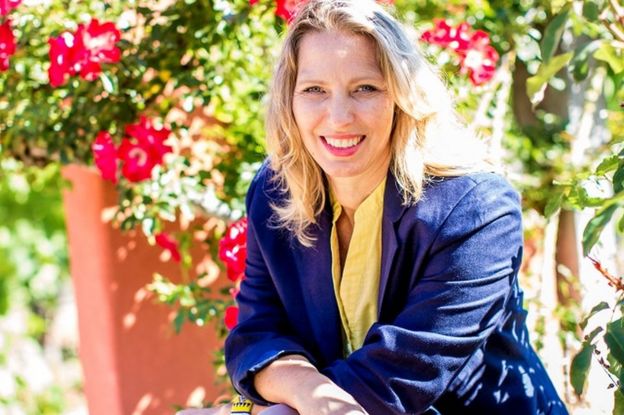
Erin MichelsonImage copyrightSUMMERY
Image captionErin Michelson had all the trappings of financial success but felt "terribly unhappy"
Erin Michelson's high-flying banking career took her to Hong Kong, Chicago, New York and San Francisco, where she rose to vice president and director of philanthropic management at Bank of America.
But despite seemingly having it all, she felt there was something missing.
"I realised that even though I had all the trappings of success, I was terribly unhappy," she says.
"So I quit my job, sold everything I owned, set up a charitable fund, and headed out on a two-year around-the-world trip volunteering with humanitarian organisations."
Taking only one suitcase, she spent 720 days travelling to 62 countries across all seven continents - an adventure that helped her find meaning in her life, she says.
After writing a book about her experiences, she returned to San Francisco and founded Summery, a data analytics company that has developed a piece of online software similar to the Myers-Briggs personality test.
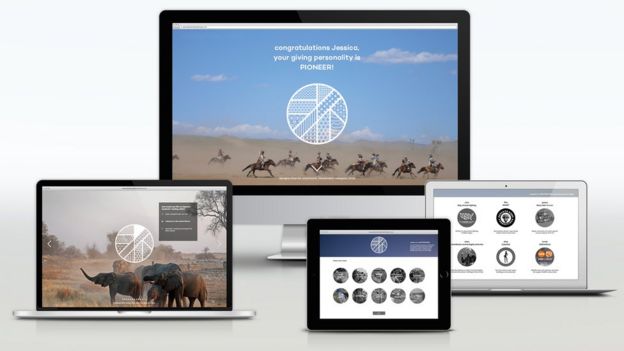
Summery software on variety of devicesImage copyrightSUMMERY
Image captionSummery helps firms match their charitable projects with their employees' personalities
The program combines behavioural science and analytics to give employers an idea of their staff's social priorities and attitudes towards giving, which she says helps inform companies how to focus their charitable efforts.
"The test matches you with one of 10 'giving' personalities and provides a snapshot of your giving DNA, one of 59,048 possibilities," says Ms Michelson.
By taking the guesswork out of charitable giving, she says it can improve the relationship between employer and staff, to everyone's benefit.
"Engaged employees lead not only to better corporate performance, but also significant cost savings through stronger retention and more targeted recruitment based on cultural appreciation," she says.
Richard Craig, chief executive of the Technology Trust, which helps charitable organisations use tech more effectively, says: "Over the last couple of years there has been a noticeable trend in graduates specifically looking for roles in charities and non-profits who might previously have looked to careers in the City, for example.
"I am seeing the same trend with technology start-ups, with a proportion looking to deliver social good either as non-profits themselves, or commercial organisation with social purpose."
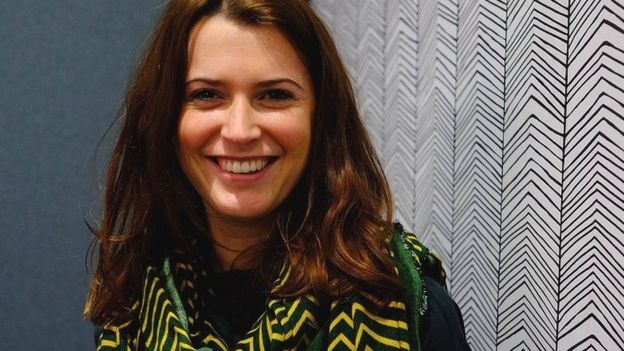
Amy Williams, found Good-LoopImage copyrightEDUARDO PAPERINI
Image captionGood-Loop's Amy Williams says she saw "untapped potential" in online advertising
It was while working for an advertising agency in London that Amy Williams had her "philtech epiphany".
"I saw firsthand the huge amount of money that gets passed from one big conglomerate to another, buying and selling the cheap commodity of our attention online," she says.
"The stark contrast between these two worlds really hit me - £4.7bn was spent on online advertising in the UK last year."
She quit and went travelling, working as a volunteer for a small charity in Argentina called Food For Thought, which specialises in nutrition education for kids.
"I started started to see the untapped potential within online advertising to make some real positive impact."
Inspired by her experiences, she founded Good-Loop, a company that rewards viewers of video ads with donations to their chosen charities.
Brands create a video and if the visitor watches it for 15 seconds or more, the advertiser pays 50p - with 50% of that going to the chosen charity, 40% to the content creator, and 10% to Good-Loop.
She says the process makes viewers more engaged with brands because they have opted to watch the content rather than having it forced upon them.
Playmob's Jude Ower believes recent political events in Europe and the US have fired up younger generations to get more involved in socially responsible causes.
"We are seeing people leave well-paid jobs to take a risk and set up on their own, not just in the hope of creating a successful start-up, but to do something with purpose."

Tuesday, 4 April 2017

Is Cadbury's move the end for Fairtrade?

h/t BBC News

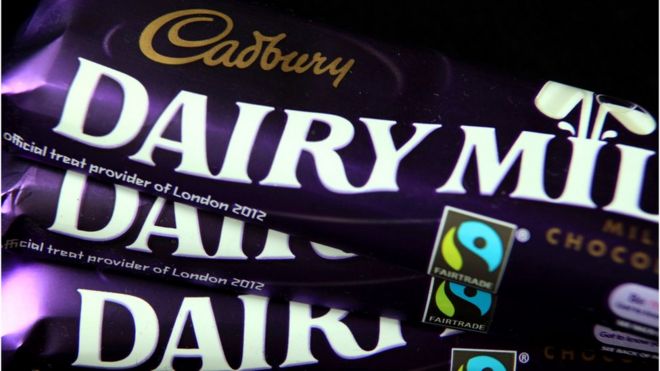
Cadbury's Dairy Milk bars

News that the UK's best known chocolate brand, Cadbury, is abandoning its Fairtrade certification has caused some concern in the food industry.
Parent company Mondelez says it plans to bring all Cadbury lines under its existing in-house fair trade scheme, Cocoa Life.
As a result, it says it will offer five times more sustainable chocolate in the UKby 2019.
But critics warn this could confuse consumers.
They also fear that shared standards around ethical trade will be lost if more firms drop Fairtrade.
So what prompted Mondelez's change of approach, and does it leave the future of the Fairtrade mark in doubt?

Mondelez's change of approach

Broadly, Fairtrade works as a voluntary certification system which holds adherents to strict standards - in particular paying a minimum price for raw materials such as cocoa, sugar and coffee.
But Glenn Caton, northern Europe president at Mondelez, tells the BBC that while his firm and Fairtrade have the same goals, "sustainability is about much more to us than price".
"The next generation of farmers aren't taking on cocoa farming like they used to because it is so unprofitable, so we have to make sure their communities thrive and this means investing more in their communities," he says.
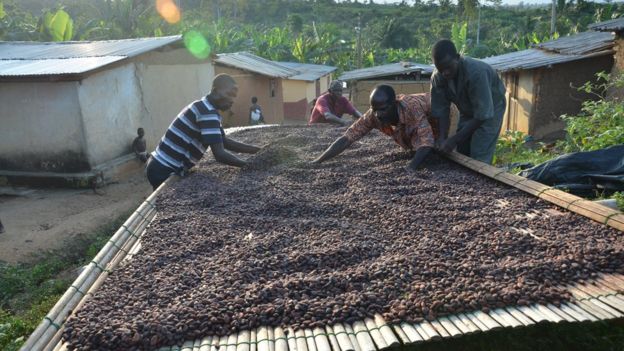
FarmersImage copyrightCOCOA LIFE
Image captionMondelez's Cocoa Life scheme aims to invest more in cocoa-producing communities
As such, Mondelez wants to lead its own sustainability efforts - investing more in areas such as its supply chain, bonuses for farmers, training and climate change prevention.
The Fairtrade Foundation has welcomed the move, too, which it says will leave farmers in developing countries like Ghana at least as well off, if not better-off.
"The relationship is not ending, it's changing," says policy and public affairs director Barbara Crowther, pointing out that the Fairtrade Foundation will remain a partner to Cocoa Life - independently assessing its progress and reporting its findings.

Fairtrade exodus?

The big question now is whether other firms will also choose to abandon Fairtrade certification and adopt their own systems of self-regulation.
Certainly criticism of the Fairtrade system is mounting in the cocoa industry, says Dr Steve Davies of the Institute of Economic Affairs.
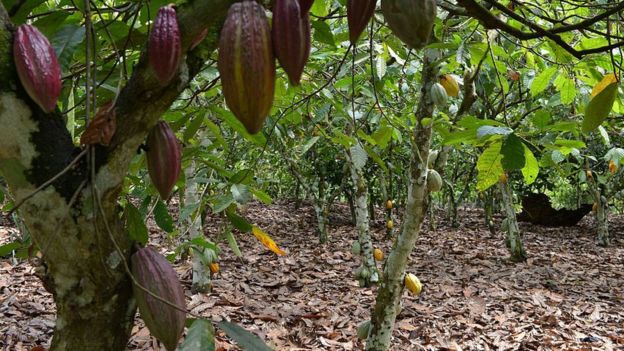
Cocoa pods in a cocoa farm in Ivory CoastImage copyrightGETTY IMAGES
Image captionThe next generation is not taking on cocoa "because it is so unprofitable", say Mondelez's Glenn Caton
The big issue is that most cocoa producers are small farmers who can't achieve the economies of scale of bigger farms, and that leaves many vulnerable to risks like drought and struggling to survive.
"Fairtrade does bring benefits to some producers, but it will not be a way of transforming the world trade system as some people seem to see it," he says.
"The only way to improve conditions for people working at bottom of the supply chain - those farming raw materials like cocoa - is by investing in the supply chain. Price floors might help but will only go so far."

Complex systems

Another issue, says Tobias Webb, of supply chain consultancy the Innovation Forum, is that firms can find the web of overlapping ethical trade certifications out there complex to manage.
These include not just Fairtrade's, but the Rainforest Alliance - which is dedicated to the conservation of tropical forests - and UTZ, the world's most prevalent label for sustainable farming.
"Producers can end up putting four or five labels on their products, and achieving each one requires a costly and time consuming audit.
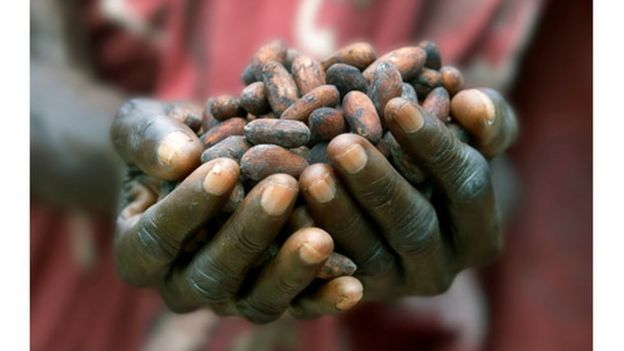
Cocoa beansImage copyrightFAIRTRADE
Image captionMany small farmers struggle to produce cocoa profitably
"So many businesses like Mondelez are now moving towards in-house systems where they work in partnership with the NGOs as independent observers.
But not everyone wants to see Fairtrade stepping back from its role as a leading promoter of ethical trade.
Anna Taylor, executive director of think-tank the Food Foundation, says the UK has seen a "rapid rise" in Fairtrade sales in the last two decades which has been of huge benefit to farmers in the developing world.
Fairtrade cocoa products by volume increased 6% in the UK in 2015, and around 4,500 products in 74 countries have the Fairtrade mark worldwide.

'Black-box supply chains'

The risk, she adds, is that we could lose a transparent set of universal standards that consumers "trust, see and recognise".
"Consumers more than ever want to be able to trust where their food comes from and are worried about 'black-box' supply chains."
Mr Webb sees another potential risk in big firms pulling away from the Fairtrade system.
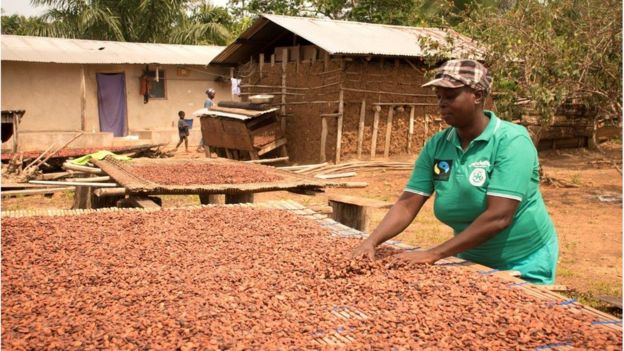
Cocoa farm workerImage copyrightFAIRTRADE
Image captionMondelez and Fairtrade will continue to work together to improve conditions on cocoa farms
"Will NGOs still be able to resource themselves to play the role of the critical friend? There is potentially a risk there that there is no independent observer - but firms do understand they need that credibility."
Ms Crowther says the Fairtrade Foundation does not see Mondelez's move as a threat to its future, and welcomes companies "taking ownership" of their sustainability challenges.
She adds that her organisation is also evolving to meet the cocoa industry's changing needs and moving beyond its historical focus on price regulation.
"If there is an opportunity to innovate in different way then we welcome it. It's also worth mentioning that Mondelez will continue to source the same amount of Fairtrade-certified sugar for its products.
"We are still the most recognisable ethical-trade mark globally and that's not going to change," she adds.