Showing posts with label CNA. Show all posts
Showing posts with label CNA. Show all posts
Monday, 15 November 2021
It’s time for a conversation about justice, top Catholic scholar says

Tuesday, 24 August 2021
Wisconsin bishops encourage vaccination while affirming conscience rights
Interesting article from CNA about the ethical issues of COVID vacinations and Conscience.
The five bishops of Wisconsin on Friday issued a message encouraging vaccination against COVID-19, while maintaining that people ought not be forced to accept a COVID vaccine.
“We encourage those eligible to receive the COVID-19 vaccine to do so because it is the most effective way to combat this virus. We are all morally responsible to protect our lives and the lives of others. This is an imperative of natural law that we treasure in our faith,” the bishops wrote.
They also acknowledged “many health or ethical reasons why a person may refuse COVID-19 vaccination,” but added that “it is the responsibility of the individual” to explain their decision to decline the vaccine, and recommended that clergy not intervene in such cases.
“However, the Church also treasures her teaching on the sanctity of conscience,” they stated. “Nobody should violate the sanctity of conscience by forcing a person to do something contrary to his or her conscience.”
In cases of conscientious objection to the COVID vaccine, “[p]astors should not feel compelled to issue documentation recognizing this conscientious objection and are recommended not to do so,” the bishops stated.
The bishops stressed that anyone refusing to be vaccinated against COVID-19 must take steps to avoid spreading the virus.
“Every decision has consequences; and in this case, the person claiming a religious or ethical exemption should be ready to properly assume other scientifically recommended means of avoiding infection and contagion: face-coverings, social distancing, hand sanitizing, periodic testing, and quarantine,” the bishops wrote.
Bishops across the country have issued guidance for Catholics seeking conscience exemptions to COVID-19 vaccine mandates.
Some bishops, including the bishops of South Dakota, have explicitly supported Catholics wishing to seek conscience exemptions. In contrast, many bishops in California, as well as in Chicago and Philadelphia, have instructed clergy not to assist parishioners seeking religious exemptions to mandates, stating that there is no basis in Catholic moral teaching for rejecting vaccine mandates on religious grounds.
Quoting Pope Paul VI’s encyclical Dignitatis Humanae, the Wisconsin bishops wrote that “the Christian faithful, in common with all other men, possess the civil right not to be hindered in leading their lives in accordance with their consciences.”
Given “the urgency of this pandemic and the frustration some may experience because of the number of unvaccinated people,” a person’s conscientious refusal of a COVID vaccine may offend some, the bishops said, but that decision still retains its “dignity,” they wrote.
“Consequently, someone who in conscience decides that he or she should not receive the COVID-19 vaccine should be granted an exemption based on his or her beliefs or convictions,” the bishops asserted.
“It is the responsibility of the individual to raise moral or ethical objections to vaccination based on the dictates of his or her conscience. Pastors should not feel compelled to issue documentation recognizing this conscientious objection and are recommended not to do so.”
Before COVID-19 vaccines were authorized for use in the United States, some Catholics raised concerns about their use of cell lines likely derived from fetal tissue of an abortion decades prior. Those vaccines produced by Pfizer and Moderna were tested on the controversial cell lines, while the vaccine created by Johnson & Johnson was both tested on and directly produced with the cell lines.
The U.S. Conference of Catholic Bishops, echoing guidance from the Vatican, has since stated that all three vaccines approved for use in the United States are “morally acceptable” for use despite their remote connection with abortion. If one had the ability to choose a vaccine, the bishops recommended that they choose one with the least connection to abortion.
Pope Francis has strongly encouraged vaccination, collaborating with the Ad Council on a video promoting vaccination. The pope called getting vaccinated against COVID “an act of love,” in the video.
December 2020 guidance from the Vatican’s Congregation for the Doctrine of the Faith stated that “vaccination is not, as a rule, a moral obligation,” and “therefore, it must be voluntary.”
Tuesday, 29 October 2019
Catholic, Jewish, and Muslim leaders sign declaration against euthanasia, physician-assisted suicide
By Hannah Brockhaus
.
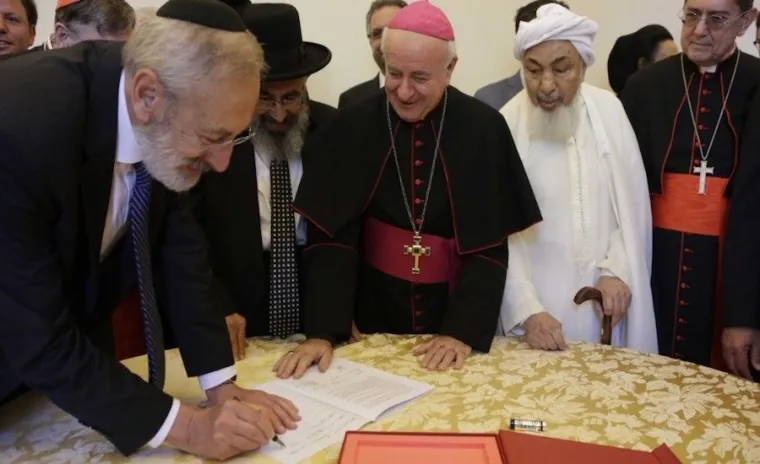
Leaders of Christianity, Judaism, and Islam presented a signed declaration to Pope Francis Monday expressing their total opposition to euthanasia and any form of physician-assisted suicide, as well as voicing their support of palliative end-of-life care.
The document was signed at the Vatican Oct. 28 by Archbishop Vincenzo Paglia, head of the Pontifical Academy for Life, along with representatives of the Jewish and Islamic faiths. It was given to Pope Francis during an audience.
The position paper states that the three Abrahamic religions “oppose any form of euthanasia – that is the direct, deliberate and intentional act of taking life – as well as physician assisted suicide – that is the direct, deliberate and intentional support of committing suicide – because they fundamentally contradict the inalienable value of human life, and therefore are inherently and consequentially morally and religiously wrong, and should be forbidden without exceptions.”
The paper also affirms the right of healthcare workers to not be coerced or pressured into directly or indirectly assisting in the intentional death of a patient through assisted suicide or any form of euthanasia, especially when doing so would violate the provider’s religious beliefs.
Even if accepted by the local legal system, “moral objections regarding issues of life and death certainly fall into the category of conscientious objection that should be universally respected,” the paper declares.
Healthcare providers, it notes, have the responsibility “to provide the best possible cure for disease and maximal care of the sick.”
The idea for the declaration came from Rabbi Avraham Steinberg, an Israeli medical ethicist, who proposed it to Pope Francis. The pope entrusted the project to the Pontifical Academy for Life, which organized an interreligious committee to create the document.
In the nearly 2,000-word position paper, it is stated that the Catholic, Jewish, and Islamic faiths “share common goals and are in complete agreement in their approach to end-of-life situations.” It also notes that these principles are sometimes in conflict with “current secular humanistic values and practices.”
The preamble to the report notes that “the moral, religious, social and legal aspects of the treatment of the dying” are among the most complex and most widely discussed in medicine today.
The issues surrounding the end of life include “difficult dilemmas,” which have increased in recent years, it argues, because of scientific-technological developments, changes in the patient-doctor relationship, cultural changes, and a growing scarcity of resources related to the expense of medical care.
These dilemmas are not primarily medical or scientific, but “social, ethical, religious, legal, and cultural,” it declares, adding that human intervention in the form of medical treatment and technologies “are only justified in terms of the help they can provide.”
“Therefore, their use requires responsible judgment about when life-sustaining and life-prolonging treatments truly support the goals of human life, and when they have reached their limits,” it claims.
The declaration states that “when death is imminent despite the means used, it is justified to make the decision to withhold certain forms of medical treatments that would only prolong a precarious life of suffering.”
However, both medical providers and society should respect the wish of a dying patient to prolong or preserve his/her life even for an additional short period of time by clinically appropriate medical measures,” it continues.
The Catechism of the Catholic Church teaches that a person may legitimately choose to discontinue medical procedures which are “over-zealous,” meaning “burdensome, dangerous, extraordinary, or disproportionate to the expected outcome..”
The position paper defines a “dying patient” as someone who has “a fatal, incurable, and irreversible disease” and is at a stage when their death will likely occur within a few months “as a result of the disease or its directly related complications, despite the best diagnostic and therapeutic efforts.”
The report offers encouragement and support for professional palliative care for everyone, everywhere and to commend laws and policies which protect the dignity of a dying person.
It also declares a commitment to engage with communities on the issue of bioethics, and to raise public awareness about palliative care.
The paper states a belief that society has an obligation to help patients not to feel like a burden and to know the value and dignity of their life, “which deserves care and support until its natural end.”
The declaration also calls on policymakers and healthcare providers to familiarize themselves with the perspective and teaching of these religions in order to better provide medical assistance in accord with their patients’ beliefs.
“While we applaud medical science for advances to prevent and cure disease, we recognize that every life will ultimately experience death,” it states. “Care for the dying is both part of our stewardship of the Divine gift of life when a cure is no longer possible, as well as our human and ethical responsibility toward the dying (and often) suffering patient.”
h/t to CNA
Monday, 10 June 2019
New Vatican document says gender theory is 'cultural and ideological revolution'
Vatican City, Jun 10, 2019 / 08:35am h/t CNA
A Vatican department has issued a sweeping
denunciation of so-called gender theory, and affirmed the principles of human
dignity, difference, and complementarity.
“In all such [gender] theories, from the most
moderate to the most radical, there is agreement that one’s gender ends up
being viewed as more important than being of male or female sex,” the
Congregation for Catholic Education wrote June 10, in a new document entitled
“Male and Female He Created Them.”
“The effect of this move is chiefly to create a
cultural and ideological revolution driven by relativism, and secondarily a
juridical revolution, since such beliefs claim specific rights for the
individual and across society.”
The document says it aims to set out an
intellectual framework “towards a path of dialogue on the question of gender
theory in education.”
Published at the beginning of “Pride Month,”
during which many cities and corporations mark the campaign of LGBT advocacy,
the document says that the Church teaches an essential difference between men
and woman, ordered in the natural law and essential to the family and human
flourishing.
“There is a need to reaffirm the metaphysical
roots of sexual difference, as an anthropological refutation of attempts to
negate the male-female duality of human nature, from which the family is
generated,” the document explains.
“The denial of this duality not only erases the
vision of human beings as the fruit of an act of creation but creates the idea
of the human person as a sort of abstraction who ‘chooses for himself what his
nature is to be.’”
The text, signed by Cardinal Giuseppe Versaldi,
prefect of the Congregation for Catholic Education, outlines the philosophical
origins of the gender theory movement, and notes the broad movement to enshrine
its distinct anthropology in policy and law.
The Congregation explains that, beginning in the
middle of the twentieth century, a series of studies were published which
proposed that external conditioning had the primary determinative influence on
personality. When such studies were applied to human sexuality, the document
says, they did so with a view to demonstrating that sexuality identity was more
a social construct than a given natural or biological fact.
“These schools of thought were united in denying
the existence of any original given element in the individual, which would
precede and at the same time constitute our personal identity, forming the
necessary basis of everything we do.”
“Over the course of time, gender theory has
expanded its field of application. At the beginning of the 1990s, its focus was
upon the possibility of the individual determining his or her own sexual
tendencies without having to take account of the reciprocity and
complementarity of male-female relationships, nor of the procreative end of
sexuality,” the document says.
The result was a “radical separation between
gender and sex, with the former having priority over the later.”
The problem with this theory, according to the
Congregation, is not the distinction between the two terms, which can be
properly understood, but in the separation of the two from each other.
“The propositions of gender theory converge in
the concept of ‘queer’, which refers to dimensions of sexuality that are
extremely fluid, flexible, and as it were, nomadic.”
The result of this ideological trend, according
to the Congregation’s assessment, is an undermining of the family.
“[In gender theory] the only thing that matters
in personal relationships is the affection between the individuals involved,
irrespective of sexual difference or procreation which would be seen as
irrelevant in the formation of families.”
“Thus, the institutional model of the family
(where a structure and finality exist independent of the subjective preferences
of the spouses) is bypassed, in favor of a vision of family that is purely
contractual and voluntary.”
The document said that despite the challenges,
dialogue remains possible. It also called for protection of human and family
rights, decried unjust discrimination, and noted points of unity among people
of divergent perspectives on gender ideology.
“For instance, educational programs on this area
often share a laudable desire to combat all expressions of unjust discrimination,
a requirement that can be shared by all sides,” the document said.
“Indeed, it cannot be denied that through the
centuries forms of unjust discrimination have been a sad fact of history and
have also had an influence within the Church. This has brought a certain
rigid status quo, delaying the necessary and progressive
inculturation of the truth of Jesus’ proclamation of the equal dignity
of men and women, and has provoked accusations of a sort of masculinist
mentality, veiled to a greater or lesser degree by religious motives.”
The aim of the Church at the institutional and
individual level must be the education of children in line with authentic
principles which defend and instil authentic human dignity, the Congregation
explains.
“In practice, the advocacy for the different
identities often presents them as being of completely equal value compared
to each other.”
“The generic concept of ‘non-discrimination’
often hides an ideology that denies the difference as well as natural
reciprocity that exists between men and women.”
Referencing classical philosophy, historic
Church teaching, Vatican Council II and the writings of several popes, the
document explains the Church’s understanding of a Christian anthropology,
insisting that it be at the heart of human formation.
For Christians working in schools, both
religious and secular, the radical individualism of gender theory should be
avoided in favor of teaching children “to overcome their individualism and
discover, in the light of faith, their specific vocation to live responsibly in
a community.”
Above all, the document says, the family remains
“the primary community” to which the students belong and the fundamental
vehicle for preserving, understanding, and transmitting human dignity.
“The school must respect the family’s culture.
It must listen carefully to the needs that it finds and the expectations that
are directed towards it.”
In the modern context, however, the essential
alliance between school and family “has entered into crisis,” the Congregation
notes.
“There is an urgent need to promote a new
alliance that is genuine and not simply at the level of bureaucracy, a shared
project that can offer a ‘positive and prudent sexual education’ that can
harmonise the primary responsibility of parents with the work of teachers.”
“Although ideologically-driven approaches to the
delicate questions around gender proclaim their respect for diversity, they
actually run the risk of viewing such difference as static realities and end up
leaving them isolated and disconnected from each other,” the document
concludes.
Promoting a culture of dialogue between the Church
and those advancing gender theory principles must take place, the document
says, in a manner that respects “the legitimate aspirations of Catholic schools
to maintain their own vision of human sexuality,” based on “an integral
anthropology capable of harmonizing the human person’s physical, psychic and
spiritual identity.”
The congregation ends by insisting on the rights
of the Church, the family, and of Catholic educators to defend authentic
teaching and understanding in the face of an increasingly exclusivist approach
to education in line with secular progressive principles.
“A democratic state cannot reduce the range of
education on offer to a single school of thought, all the more so in relation
to this extremely delicate subject, which is concerned on the one hand with the
fundamentals of human nature, and on the other with natural rights of parents
to freely choose any educational model that accords with the dignity of the
human person.”
Sunday, 10 February 2019
The 70th miracle: Lourdes healing officially declared supernatural
18
Lourdes,
France, Feb 12, 2018 / 02:00 pm (CNA/EWTN News)

A
miracle was officially recognized at the Marian shrine of Our Lady of Lourdes
in France, the 70th Lourdes miracle recognized by the Catholic Church.
The miracle was
officially declared by Bishop Jacques Benoit-Gonin of Beauvais, France on Feb.
11, the World Day of the Sick and the feast day of Our Lady of Lourdes. During
Mass at the shrine’s basilica, Bishop Nicolas Brouwet of Lourdes announced the
miracle.
The miraculous event
involved a French nun, Sister Bernadette Moriau, who went on a pilgrimage to
the shrine of Our Lady of Lourdes in 2008. She had been suffering from spinal
complications which had rendered her wheelchair-bound and fully disabled since
1980. She also said she had been taking morphine to control the pain.
When Sister Moriau
visited the Lourdes Shrine almost a decade ago, she said she “never asked for a
miracle,” according to the Associated Press.
However, after attending
a blessing for the sick at the shrine, something began to change.
“I felt a [surge of]
well-being throughout my body, a relaxation, warmth…I returned to my room and
there, a voice told me to ‘take off your braces,’” recalled the now 79-year old
nun.
“Surprise. I could
move,” Moriau said, noting that she instantaneously walked away from her
wheelchair, braces, and pain medications.
Moriau’s case was
brought to the attention of the International Medical Committee of Lourdes, who
extensively researched the nun’s recovery. They eventually found that Moriau’s
healing could not be scientifically explained.
After a healing is
recognized by the Lourdes committee, the paperwork is then sent to the diocese
of origin, where the local bishop has the final say. After the bishop’s
blessing, a healing can then be officially recognized by the Church as a
miracle.
The shrine of Our Lady
of Lourdes in southern France is a popular pilgrimage destination for
individuals with special devotions to Mary and for those seeking miraculous
healings. It is the site where young Bernadette Soubirous witnessed Marian
apparitions, beginning on Feb. 11, 1858. The shrine also holds a spring of
water which is said to have miraculous healing properties.
While there have been
more than 7,000 miraculous recoveries attributed to the intercession of Our
Lady of Lourdes at the French shrine, only 70 cases have been officially
recognized by the Catholic Church. A miraculous recovery must generally be a
complete, spontaneous, and immediate healing from a documented medical
condition.
The last official
miracle attributed to the intercession of Our Lady of Lourdes was declared in 2013.
Subscribe to:
Posts (Atom)