In a world where assisted reproduction is becoming increasingly common, bioethicists are beginning to ask the question: “what counts as genetic parenthood?”.
It is tempting to think that genetic parenthood is about sharing half of one’s genes with another person. But this alone is not enough. Imagine a situation in which you had an identical twin, and your twin had a child. The child of your identical twin would share half of your genes. But would this make you their parent as well? Our intuitions tell us “no”.
In a new article in The Philosophical Quarterly, State University of New York philosopher Monika Pitrowska attempts to offer an account genetic parenthood that deals some of the complexities of the parent-offspring relationship. According to Pitrowska, there are three criteria that must be met for something to count as genetic parenthood: overlap, development, and persistence.
Readers may consult the article for a full development of the argument. Yet to provide a basic summary, Pitrowska argues that mere genetic similarity, or causal relationships between parents and children, are insufficient as a definition of parenthood. An vital feature of genetic parenthood is the passage of genetic material from one generation down through several successive generations. Pitrowska develops an definition that tracks this specific feature of parenthood.
As Pitrowska observes, the question of genetic parenthood is more than an esoteric, philosophical matter. While assisted reproduction has transformed society’s understanding of the family unit, our concern to know our genealogy remains. Furthermore, in a world where we are questioning whether mitochondrial replacement therapy creates three parent babies, or whether surrogates have a genetic link to the children they bear, it is important to achieve conceptual clarity.
In a new article in the Journal of Medical Ethics, researchers from the National Institutes of Health offer an insightful analysis of one of the most controversial cases of euthanasia to have occured in the Netherlands.
Bioethicists David Gibbs Miller, Rebecca Dresser and Scott Kim analyse the official medical records of a severely demented woman who was euthanized in Holland in 2016. The woman, who was in her 70s, had her life ended by a geriatrician in aged care facility after having written an advance directive indicating her wishes for receiving euthanasia.
The advance care directive was written several years before her death, and there has been much discussion about whether it remained binding.
The most controversial feature of the case, however, was the manner in which the woman was euthanised. The supervising doctor mixed sedatives into the coffee of the woman without her knowledge. When the sedatives did not work, the doctor administered a stronger drug subcutaneously.
While the doctor was administering the lethal dose, the patient tried to get up and had to be restrained by family members.
The authors observe that there is insufficient scrutiny of the process by which Advance Care Directives are prepared:
...physicians and the RTE [Dutch regional euthanasia review committees] accept a low threshold of decisional capacity for preparing AEDs. The RTE’s Code of Practice states that in early dementia, "the patient generally…is decisionally competent in relation to his request for euthanasia". This apparent presumption of capacity in early AD (and in the case [of this patient], a much more advanced state) is incompatible with existing data on Alzheimer’s disease and decisional capacity.
The authors also question whether an Advance Care Directive should override the contemporaneous wishes of a severely demented patient:
The failure to provide adequate protection to a vulnerable patient was exacerbated by the failure to respect her contemporaneous interests and statements. By privileging the AED as the expression of Mrs A’s ‘real self ’—a judgement that itself was dubious in light of her questionable capacity and understanding when she made the AED—physicians failed to protect her … when they disregarded her contemporaneous statements and actions.
A controversial new documentary has been released in the US telling the story of an Oregon couple who took their own lives via lethal medication in April 2017.
The documentary recounts the story of Charlie and Francie Emerick, 88 and 87 respectively, who last year applied to the Oregon Health Authority for a lethal prescription after being diagnosed with terminal illnesses. Charlie was suffering from advanced Parkinson's Disease, and Francie had battled for several years with lymphoma.
The Emericks died at home in April 2017, surrounded by family. They had been married for 66 years.
“They were each other‘s best friend,” Jerilyn Marler, their eldest of the couple’s three children, told reporters. “In their last years, Dad was Mom’s eyes and Mom was Dad’s ears. It was natural for them to want to die together”.
The documentary presents the couple’s decision in a very favourable light, though some close friends and relatives disagreed. Bioethicist Thaddeus Mason Pope speculated that they may have been the “first couple” to take their lives together under Oregon’s Death with Dignity law. Nearly 1,300 people have died in Oregon via lethal prescription since the enactment of the law in 1997.
Jesus doesn't even make the top three when it comes to things Britons associate with Easter, according to a poll by YouGov.
Just 55% of people said that they personally associate Christ with Easter despite the very obvious fact that the Easter weekend constitutes the biggest event in the Christian calendar.
This makes Jesus the fourth most common Easter associated for people in the UK - behind chocolate Easter eggs (76%), bank holidays (67%) and hot cross buns (62%).
Use regions/landmarks to skip ahead to chart.
What do Britons associate with Easter?. Proportion of respondents selecting each option
Long description.
No description available.
Structure.
Chart type: column chart.
column series with 12 columns.
The chart has 1 X axis displaying categories.
The chart has 1 Y axis displaying values.
Chart graphic.Among young people Jesus is even less likely to be associated with Easter, with just 44pc of those aged 18-24 and 45pc of those aged 25-49 picking him as an option.
Jude Ower loved playing video games as a child, but she never dreamed that her passion would eventually become a force for good and win her accolades and honours.
After 12 years making games for education and training, she went on to create an international games platform with a social conscience - Playmob.
"After the 2010 Haiti earthquake, Zynga, the creator of Farmville, launched a campaign to raise funds for the victims by selling an in-game item, with a percentage of each purchase going to help the victims," she explains.
"It was massively successful and raised over $1m in a matter of days. It was then I thought: 'Maybe I could make a platform that connected games and causes?'"
Playmob pairs games developers or businesses with a charity and then sets up in-game advertising campaigns. By clicking on links within the game, players can make donations.
The campaigns have helped more than 3,000 teenagers receive counselling for cyber-bullying, provided protection for 31 pandas, and secured education for 8,500 children in Africa and Asia, the company says.
"With Playmob we can track the social impact, such as number of trees planted, number of meals provided, water wells built, and so forth," she says.
"This allows players to see that the more they play and interact with the branded content, the more good they do."
So far the games platform has raised more than $1m for charities over the past five years, and more than 1.5 million players have interacted with charitable in-game content.
Her success saw her awarded an MBE (Member of the Order of the British Empire) in 2015 for services to entrepreneurship and she's been voted one of the top 100 Women in Tech in Europe.
Ms Ower is just one of a growing number of entrepreneurs - many of them women - exploring how technology can be harnessed in the cause of philanthropy.
This is tech for social good, or "philtech" as it's sometimes called.
Image copyrightSUMMERYImage captionErin Michelson had all the trappings of financial success but felt "terribly unhappy"
Erin Michelson's high-flying banking career took her to Hong Kong, Chicago, New York and San Francisco, where she rose to vice president and director of philanthropic management at Bank of America.
But despite seemingly having it all, she felt there was something missing.
"I realised that even though I had all the trappings of success, I was terribly unhappy," she says.
"So I quit my job, sold everything I owned, set up a charitable fund, and headed out on a two-year around-the-world trip volunteering with humanitarian organisations."
Taking only one suitcase, she spent 720 days travelling to 62 countries across all seven continents - an adventure that helped her find meaning in her life, she says.
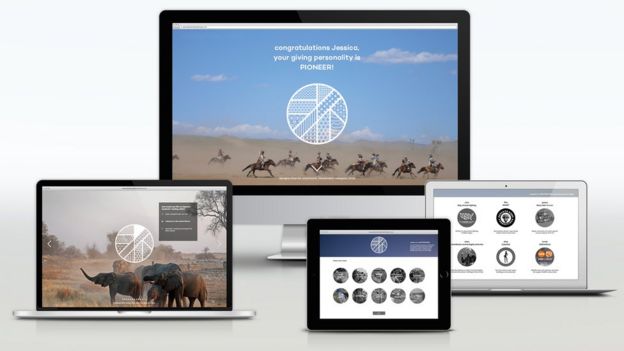
After writing a book about her experiences, she returned to San Francisco and founded Summery, a data analytics company that has developed a piece of online software similar to the Myers-Briggs personality test.
Image copyrightSUMMERYImage captionSummery helps firms match their charitable projects with their employees' personalities
The program combines behavioural science and analytics to give employers an idea of their staff's social priorities and attitudes towards giving, which she says helps inform companies how to focus their charitable efforts.
"The test matches you with one of 10 'giving' personalities and provides a snapshot of your giving DNA, one of 59,048 possibilities," says Ms Michelson.
By taking the guesswork out of charitable giving, she says it can improve the relationship between employer and staff, to everyone's benefit.
"Engaged employees lead not only to better corporate performance, but also significant cost savings through stronger retention and more targeted recruitment based on cultural appreciation," she says.
Richard Craig, chief executive of the Technology Trust, which helps charitable organisations use tech more effectively, says: "Over the last couple of years there has been a noticeable trend in graduates specifically looking for roles in charities and non-profits who might previously have looked to careers in the City, for example.
"I am seeing the same trend with technology start-ups, with a proportion looking to deliver social good either as non-profits themselves, or commercial organisation with social purpose."
Image copyrightEDUARDO PAPERINIImage captionGood-Loop's Amy Williams says she saw "untapped potential" in online advertising
It was while working for an advertising agency in London that Amy Williams had her "philtech epiphany".
"I saw firsthand the huge amount of money that gets passed from one big conglomerate to another, buying and selling the cheap commodity of our attention online," she says.
"The stark contrast between these two worlds really hit me - £4.7bn was spent on online advertising in the UK last year."
She quit and went travelling, working as a volunteer for a small charity in Argentina called Food For Thought, which specialises in nutrition education for kids.
"I started started to see the untapped potential within online advertising to make some real positive impact."
Inspired by her experiences, she founded Good-Loop, a company that rewards viewers of video ads with donations to their chosen charities.
Brands create a video and if the visitor watches it for 15 seconds or more, the advertiser pays 50p - with 50% of that going to the chosen charity, 40% to the content creator, and 10% to Good-Loop.
She says the process makes viewers more engaged with brands because they have opted to watch the content rather than having it forced upon them.
Playmob's Jude Ower believes recent political events in Europe and the US have fired up younger generations to get more involved in socially responsible causes.
"We are seeing people leave well-paid jobs to take a risk and set up on their own, not just in the hope of creating a successful start-up, but to do something with purpose."
Warning to Not Misuse Biotechnologies, Reminds That Sciences and Technology Are Made for Man and World, Not Vice Versa
PHOTO.VA - L'OSSERVATORE ROMANO
“The principle of accountability is an essential cornerstone of human action, and man must answer for his own acts and omissions before himself, others and ultimately God.”
Pope Francis sent this strong message to members of the National Committee for Biosafety, Biotechnology and Life Sciences at an audience in the Vatican, this morning, April 10, 2017, on the occasion of the 25th anniversary of the institution of the committee at the Presidency of the Council of Ministers.
The Pontiff began greeting those present and acknowledging that the themes and issues that their committee faces are of great importance for contemporary man, both as an individual and in the relational and social dimension, starting with the family and also in local and national as well as international communities, and in care for creation.
With this in mind, the Pope stressed, “let me remind you that the sciences and technologies are made for man and for the world, not the man and the world for science and technology.”
“They are at the service of a dignified and healthy life for all, now and in the future, and make our common home more liveable and supportive, more careful and guarded.”
The Pope had began his address recalling that in the book of Genesis, we read:“the Lord God took the man and put him in the garden of Eden to till it and keep it” (2:15). Francis reminded them of how essential it is that they remember that in whatever they do, they are to “cultivate” and “keep” the garden of the world, which entails caring for, protecting, overseeing and preserving.
Predict, Prevent Manipulation of Life
“Your task,” the Pontiff highlighted, “is not only that of promoting the harmonious and integrated development of scientific and technological research that relates to the biological processes of plant, animal and human life; you are also asked to predict and prevent the negative consequences that can result in a distorted use of knowledge and skills to manipulate life.”
The scientist, like the technologist, the Pope explained, is called to “know” and “know how” with increasing precision and creativity in his or her field of competence and, at the same time, “make responsible decisions on steps to be taken, and those before which it is necessary to stop, and take a different road.”
Accountability
“The principle of accountability is an essential cornerstone of human action, and man must answer for his own acts and omissions before himself, others and ultimately God.”
Technologies, even more than sciences, the Pope stressed, put in the hands of man an enormous and growing power.
“The major risk,” he highlighted, “is that citizens, and sometimes even those who represent them and govern them, do not fully realize the seriousness of the challenges that arise, the complexity of the problems to be solved, and the danger of misusing the power that sciences and the technologies of life put in our hands (see Romano Guardini, The end of the modern era , Brescia 1987, pp. 80-81).”
Pope Francis concluded, saying, “May the Lord bless each one of you, your families and your valuable work,”and saying pray for me as I pray for you.
They also fear that shared standards around ethical trade will be lost if more firms drop Fairtrade.
So what prompted Mondelez's change of approach, and does it leave the future of the Fairtrade mark in doubt?
Mondelez's change of approach
Broadly, Fairtrade works as a voluntary certification system which holds adherents to strict standards - in particular paying a minimum price for raw materials such as cocoa, sugar and coffee.
But Glenn Caton, northern Europe president at Mondelez, tells the BBC that while his firm and Fairtrade have the same goals, "sustainability is about much more to us than price".
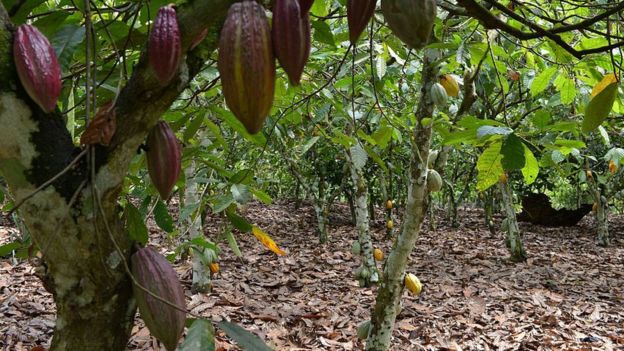
"The next generation of farmers aren't taking on cocoa farming like they used to because it is so unprofitable, so we have to make sure their communities thrive and this means investing more in their communities," he says.
Image copyrightCOCOA LIFEImage captionMondelez's Cocoa Life scheme aims to invest more in cocoa-producing communities
As such, Mondelez wants to lead its own sustainability efforts - investing more in areas such as its supply chain, bonuses for farmers, training and climate change prevention.
The Fairtrade Foundation has welcomed the move, too, which it says will leave farmers in developing countries like Ghana at least as well off, if not better-off.
"The relationship is not ending, it's changing," says policy and public affairs director Barbara Crowther, pointing out that the Fairtrade Foundation will remain a partner to Cocoa Life - independently assessing its progress and reporting its findings.
Fairtrade exodus?
The big question now is whether other firms will also choose to abandon Fairtrade certification and adopt their own systems of self-regulation.
Certainly criticism of the Fairtrade system is mounting in the cocoa industry, says Dr Steve Davies of the Institute of Economic Affairs.
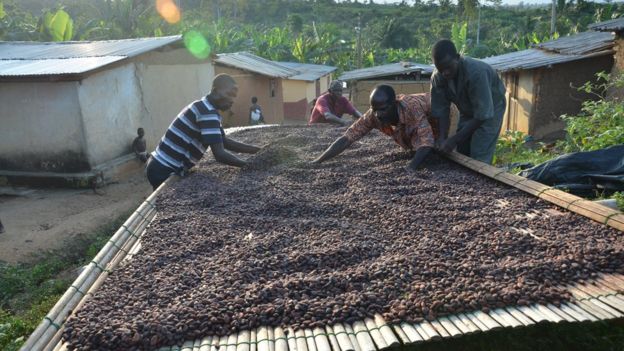
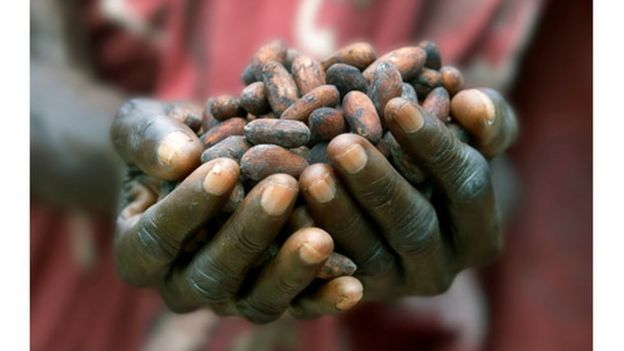
Image copyrightGETTY IMAGESImage captionThe next generation is not taking on cocoa "because it is so unprofitable", say Mondelez's Glenn Caton
The big issue is that most cocoa producers are small farmers who can't achieve the economies of scale of bigger farms, and that leaves many vulnerable to risks like drought and struggling to survive.
"Fairtrade does bring benefits to some producers, but it will not be a way of transforming the world trade system as some people seem to see it," he says.
"The only way to improve conditions for people working at bottom of the supply chain - those farming raw materials like cocoa - is by investing in the supply chain. Price floors might help but will only go so far."
Complex systems
Another issue, says Tobias Webb, of supply chain consultancy the Innovation Forum, is that firms can find the web of overlapping ethical trade certifications out there complex to manage.
These include not just Fairtrade's, but the Rainforest Alliance - which is dedicated to the conservation of tropical forests - and UTZ, the world's most prevalent label for sustainable farming.
"Producers can end up putting four or five labels on their products, and achieving each one requires a costly and time consuming audit.
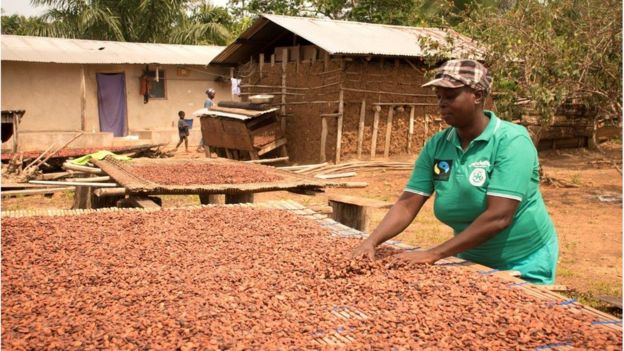
Image copyrightFAIRTRADEImage captionMany small farmers struggle to produce cocoa profitably
"So many businesses like Mondelez are now moving towards in-house systems where they work in partnership with the NGOs as independent observers.
But not everyone wants to see Fairtrade stepping back from its role as a leading promoter of ethical trade.
Anna Taylor, executive director of think-tank the Food Foundation, says the UK has seen a "rapid rise" in Fairtrade sales in the last two decades which has been of huge benefit to farmers in the developing world.
Fairtrade cocoa products by volume increased 6% in the UK in 2015, and around 4,500 products in 74 countries have the Fairtrade mark worldwide.
'Black-box supply chains'
The risk, she adds, is that we could lose a transparent set of universal standards that consumers "trust, see and recognise".
"Consumers more than ever want to be able to trust where their food comes from and are worried about 'black-box' supply chains."
Mr Webb sees another potential risk in big firms pulling away from the Fairtrade system.
Image copyrightFAIRTRADEImage captionMondelez and Fairtrade will continue to work together to improve conditions on cocoa farms
"Will NGOs still be able to resource themselves to play the role of the critical friend? There is potentially a risk there that there is no independent observer - but firms do understand they need that credibility."
Ms Crowther says the Fairtrade Foundation does not see Mondelez's move as a threat to its future, and welcomes companies "taking ownership" of their sustainability challenges.
She adds that her organisation is also evolving to meet the cocoa industry's changing needs and moving beyond its historical focus on price regulation.
"If there is an opportunity to innovate in different way then we welcome it. It's also worth mentioning that Mondelez will continue to source the same amount of Fairtrade-certified sugar for its products.
"We are still the most recognisable ethical-trade mark globally and that's not going to change," she adds.