Friday, 22 March 2019

Assisted dying: Doctors' group adopts neutral position

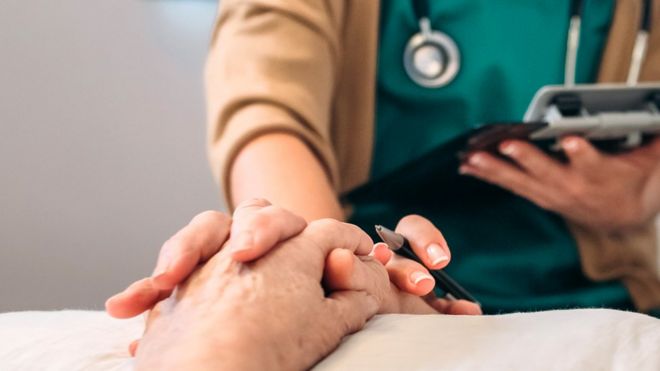
file picture of doctor holding patient's handImage copyrightGETTY IMAGES
Hospital doctors have dropped their 13-year opposition to the concept of helping terminally ill patients die.
Following a poll of its members, the Royal College of Physicians has now adopted a neutral stance on the issue of assisted dying.
Some groups have spoken out against the change, saying a respected medical body's reputation has been damaged. Others called the decision "absurd".
Under UK law, it is illegal to encourage or assist a suicide.
Nearly 7,000 doctors voted in the online poll:
  • 43% thought the college should oppose a change in the law
  • 32% wanted the college to support a change
  • 25% were neutral
And the college has shifted to a neutral stance because neither side achieved a majority of 60%.
However, a group of doctors opposed to any change in the college's position are planning to challenge the decision to ask for a majority result.
Royal College of Physicians (RCP) president Prof Andrew Goddard said: "It is clear that there is a range of views on assisted dying in medicine, just as there is in society.
"We have been open from the start of this process that adopting a neutral position will mean that we can reflect the differing opinions among our membership.
"Neutral means the RCP neither supports nor opposes a change in the law and we won't be focusing on assisted dying in our work.
"Instead, we will continue championing high-quality palliative care services."

'Absurd decision'

Dr Gordon Macdonald, chief executive of Care Not Killing, said most doctors didn't want a change in the law on assisted suicide or euthanasia.
"We hope that the RCP will listen to this message from their members and reverse their absurd decision to adopt a position that is the least popular and commands the support of just one in four of doctors," he said.
"This is why our view is clear, society should be doing everything in our power to prevent suicide, not assist it."
Campaign group Living and Dying Well said the shift had damaged the college's reputation as a professional body.

A line

Analysis by Fergus Walsh, BBC medical correspondent

This shift by the Royal College of Physicians has no effect on the law and does not bring assisted dying any closer.
But it is symbolic that a respected body should change its stance and has been warmly welcomed by campaigners aiming to change the law.
The decision has infuriated and dismayed those opposed to the change, however, who argue that it is unreasonable to demand a supermajority in order to maintain the status quo.
The RCP has revealed that only one of the 39 specialisms it represents met the 60% threshold.
Of palliative medicine doctors, 80% voted to maintain the college's opposition to assisted dying.
This is a group who will spend more time than any other with patients at the end of life, so their view is significant.
The RCP also pointed out that it had adopted a neutral position until 2006 and so this move was a return to its previous stance.
A line
The BMA, the doctors' trade union, is opposed to assisted dying. Motions calling for it to adopt a neutral position have been repeatedly rejected.
Dr John Chisholm, BMA medical ethics committee chair, said: "Our focus remains on improving the standard of palliative care available for patients, through calling for greater investment and support to enable staff to deliver the highest quality end-of-life care."

From the BBC news website

Sunday, 17 March 2019

Back to the source: the Hippocratic Oath re-examined

Over the centuries the Hippocratic Oath has expressed the ideals of the medical profession, although nowadays other versions have supplanted it for graduating medical students– if they take any oath at all. If taken literally the Oath is an anachronism. Who today “swears by Apollo Physician, by Asclepius, by Hygieia, by Panacea, and by all the gods and goddesses”?
Image result for the hippocratic oathBut T. A. Cavanaugh, a philosopher at the University of San Francisco, argues in his recent book Hippocrates' Oath and Asclepius' Snake: The Birth of the Medical Profession that the Oath is still relevant in establishing the fundamental ethics of the medical profession—to help and not to harm the sick.
Steeped in Hellenic culture and philosophy, Cavanaugh argues that deliberate iatrogenic harm, especially the harm of a doctor choosing to kill (physician assisted suicide, euthanasia, abortion, and involvement in capital punishment), amounts to an abandonment of medicine as an exclusively therapeutic profession.
Medicine as a profession, Cavanaugh contends, necessarily involves declaring the good one seeks and the bad one seeks to avoid on behalf of the sick. The idea of taking an oath implies that doctors set boundaries around what they are permitted to do. Medicine must reject the view that it is purely a technique lacking its own unique internal ethic.
h/t Bioedge

Sunday, 10 February 2019

The 70th miracle: Lourdes healing officially declared supernatural


18
Lourdes, France, Feb 12, 2018 / 02:00 pm (CNA/EWTN News)

Image result for our lady of lourdes grotto

A miracle was officially recognized at the Marian shrine of Our Lady of Lourdes in France, the 70th Lourdes miracle recognized by the Catholic Church.

The miracle was officially declared by Bishop Jacques Benoit-Gonin of Beauvais, France on Feb. 11, the World Day of the Sick and the feast day of Our Lady of Lourdes. During Mass at the shrine’s basilica, Bishop Nicolas Brouwet of Lourdes announced the miracle.
The miraculous event involved a French nun, Sister Bernadette Moriau, who went on a pilgrimage to the shrine of Our Lady of Lourdes in 2008. She had been suffering from spinal complications which had rendered her wheelchair-bound and fully disabled since 1980. She also said she had been taking morphine to control the pain.
When Sister Moriau visited the Lourdes Shrine almost a decade ago, she said she “never asked for a miracle,” according to the Associated Press.
However, after attending a blessing for the sick at the shrine, something began to change.
“I felt a [surge of] well-being throughout my body, a relaxation, warmth…I returned to my room and there, a voice told me to ‘take off your braces,’” recalled the now 79-year old nun.
“Surprise. I could move,” Moriau said, noting that she instantaneously walked away from her wheelchair, braces, and pain medications.
Moriau’s case was brought to the attention of the International Medical Committee of Lourdes, who extensively researched the nun’s recovery. They eventually found that Moriau’s healing could not be scientifically explained.
After a healing is recognized by the Lourdes committee, the paperwork is then sent to the diocese of origin, where the local bishop has the final say. After the bishop’s blessing, a healing can then be officially recognized by the Church as a miracle.
The shrine of Our Lady of Lourdes in southern France is a popular pilgrimage destination for individuals with special devotions to Mary and for those seeking miraculous healings. It is the site where young Bernadette Soubirous witnessed Marian apparitions, beginning on Feb. 11, 1858. The shrine also holds a spring of water which is said to have miraculous healing properties.
While there have been more than 7,000 miraculous recoveries attributed to the intercession of Our Lady of Lourdes at the French shrine, only 70 cases have been officially recognized by the Catholic Church. A miraculous recovery must generally be a complete, spontaneous, and immediate healing from a documented medical condition.
The last official miracle attributed to the intercession of Our Lady of Lourdes was declared in 2013.


Organ donation euthanasia is gaining traction

h/t to Bioedge
You should be able to read both Kantian and Utilitarian ideas being articulated. Whilst you need to refer to Natural Moral Law and Situation Ethics in your exam this could be a useful read.
The idea of organ donation euthanasia (ODE) is slowly garnering support in academic bioethics. In 2012, Oxford bioethicists Dominic Wilkinson and Julian Savulescu argued that chronic organ shortages provided good utilitarian justification for permitting ODE. More recently, Harvard bioethicist Robert Truog and two doctors from Western University argued in the New England Journal of Medicine that Canadian euthanasia legislation should be amended to allow for ODE.
Now a group of transplant surgeons have written an article defending ODE in one of the world’s leading transplantation journals, The Journal of Heart and Lung Transplantation.
The authors -- several doctors and ethicists from universities and hospitals in the Benelux region -- discuss both the ethics and legality of ODE. They focus in particular on Belgium and the Netherlands, where euthanasia has been legal for several years.
Currently ODE is not explicitly legal in either of these countries, though the authors suggest that there may be potential loopholes in the law.
While ODE may violate the dead donor rule, the authors argue that it is still compatible with respect for persons:
"...it is our belief that a physician should always inform a patient who is medically suitable about the possibility of organ donation, even if this could disrupt the trust relationship, as many patients may choose not to ask about donation because they assume it is not possible in this context”. 
They authors claim that organ donation euthanasia does not amount to an instrumentalisation of patients:
“[One] ethical objection to living donation and euthanasia is that people are instrumentalized to obtain organs; people could be pressured to undergo euthanasia in order to donate, whereas the public may believe euthanasia was only granted to make organ donation possible. The topic of organ donation is therefore only to be discussed after a positive decision on euthanasia has been made". 
The authors also suggest that the benefits of ODE -- in terms of lives saved -- may potentially outweigh any negative impacts that the procedure may have on public trust.
Bioethicist Wesley Smith said the article was a confirmation of his concerns about a ‘euthanasia slippery slope’. In a blog post, he warned against accepting ODE:
"May the public never be ready to accept doctors’ taking a living patient — who may not even be physically ill — into a surgical suite, anesthetizing him, and then harvesting his beating heart".

Sunday, 10 June 2018

What are the five best arguments against euthanasia?

h/t Bioedge


As medical societies around the world consider changes to their position on euthanasia, several influential doctors and ethicists have co-published a commentary in the Journal of Palliative Care opposing any policy change.

Among the authors of the article, entitled “Physician-Assisted Suicide and Euthanasia: Emerging Issues From a Global Perspective”, are Georgetown University’s Daniel Sulmasy, who served on President Obama’s Commission for the Study of Bioethical Issues, Margaret Somerville, a legal scholar and one of the most vocal opponents of the legalisation of euthanasia in Canada, and influential palliative care specialist Lukas Radbruch.

The authors summarise what they take to be the five strongest reasons to oppose euthanasia. They include:
1) “slippery slopes”: The authors assert that “despite safeguards for euthanasia in the Netherlands and Belgium, there are data that safeguards are ineffective and violated...Allowing voluntary euthanasia has led to nonvoluntary euthanasia”.
2) “lack of self-determination”: The authors note that many expressions of a desire for death do not mean that a patient wants to euthanasia or assisted suicide; “As individual requests for PAS-E are often labile, complex in origin, and subject to the individual’s changing priorities, such requests require careful and repetitive attention”.
3) “inadequate palliative care”: “Holistic knowledge of palliative care”, they state, “is the most urgent ethical obligation of jurisdictions worldwide rather than legalizing PAS-E
4) “medical professionalism”: doctors assisting in PAS-E, the authors argue, threaten the moral integrity of the medical profession.
5) “difference between means and ends”: the push for PAS-E confuses the problem of suffering with the life of the person: “we must kill the pain and suffering, not the person with the pain and suffering”.

Coincidentally, a completely different vision of euthanasia emerges from a recent article in the Belgian Tijdschrift voor Geneeskunde (Journal of Medicine). J.L. Bernheim, a researcher at the End-of-life Care Research Group, 
flatly denies that critics of Belgian euthanasia know what they are talking about. He divides criticisms into pragmatic (factual) and essentialist (moral and legal).
On the first score, Bernheim denies that there was or is a “slippery slope” or that vulnerable patients are not protected adequately. On the second, he argues that euthanasia is a genuinely compassionate supplement to end-of-life care. It’s an interesting to see how different euthanasia looks inside the borders of Belgium. Unfortunately, the article is available only in Dutch at the moment.

Sunday, 25 March 2018

Daniel Callahan backs ‘slippery slope’ on assisted suicide

by Michael Cook | 25 Mar 2018 |
The idea of a slippery slope for euthanasia is mocked by supporters.  But in a recent opinion piece in the Bioethics Forum of The Hastings Center, one of America’s most respected bioethicists endorses it. In a brief opinion piece, Daniel Callahan, the co-founder of The Hastings Center, the world's first bioethics research institute, and the author or editor of 47 books, writes:
I have been opposed to physician-assisted death for well over 30 years. ....
I came into the debate with wariness and curiosity. On the one hand, my work on end-of-life care and the emergent hospice movement made clear that many deaths could be painful, psychologically traumatizing, and messy. I could well understand interest in that problem, but I wondered why the growing hospice program was not enough. What was to be made of the zealotry of proponents for euthanasia or physician aid in dying? I was especially curious about their long-term aspirations.
I also became interested in the pressures that medical progress was putting on care of the dying. Most notably, it has been increasing the possibility of medical efforts to incrementally find ever more ways to keep the sick and dying alive. The logic of medical progress has an unpleasant feature. It is the gradual movement from short lives and quick death to longer lives and extended dying. The quick deaths from heart attacks in my parents’ generation have given way to longer lives and Alzheimer’s disease. Is that progress?
Interest in assisted death comes, in part, from a culture of medical progress that does not know how to stop extending our lives. Medicine is particularly good in extending our dying—and much of that extension is in old age. I believe that the care of the elderly is rapidly coming to be a crisis for many countries, rich and poor. Inevitably, this crisis has also meant a growing attraction to assisted death. Some studies show that suicide rates are especially high in countries with low birthrates, rapidly aging populations, and significant health care and caretaker costs. The U.S. may not be spared.
My introduction to the Dutch scene in the late 1980s was to see a slippery slope in the making, first in the Netherlands and then in other countries. In Belgium, for example, euthanasia is now legal for terminally ill children, as well as for adults who have mental illness and dementia, and who are “tired of living.” The loosening of restrictions on who qualifies for euthanasia is evidence of the high value placed on individual autonomy in determining the time and means of death. It is a concept with no inherent limits.

A self-driving car killed a pedestrian. What now?

by Xavier Symons | 25 Mar 2018 |
A self-driving Uber vehicle has hit and killed a pedestrian in United States, raising concerns about the regulation of new autonomous vehicle (AV) technology.
Elaine Hertzberg was struck down late on Sunday night in Tempe, Arizona, after accidently stepping in front of an AV vehicle -- an Audi SUV -- travelling at approximately 60 kph.
The vehicle’s front sensor failed to detect the woman, while a safety driver present in the car was not watching the road.
Uber has announced an immediate halt on its AV trials across North America after the incident, and police are investigating. Legislation currently being discussed in Washington will look to introduce federal safety standards for the use of AV technology.
Some analysts suggest that regulations of self-driving vehicles need to be stronger. “Moving too quickly could put lives at risk and set back a technology that could ultimately help reduce the number of people killed and injured on the roads each year”, wrote Will Knight of the MIT Technology Review.
Others suggested that fatalities are inevitable -- albeit far less likely -- with self-driving vehicles. The Economist argued that, while self-driving vehicles will reduce the number of fatalities, “the sad truth is that there are bound to be fatal accidents on the road to a driverless world”.
These robot vehicles have a link to bioethics, especially to the well-known utilitarian trolley problem. After all, someone has to program them to make “decisions” about what to do when faced with conflicting choices.
Last year the German Federal cabinet adopted 20 recommendations by the Ethics Commission on Automated Driving, as a basis for the local car industry to advance its driverless technology. But it noted that “at the level of what is technologically possible today […] it will not be possible to prevent accidents completely. This makes it essential that decisions be taken when programming the software of conditionally and highly automated driving systems.”